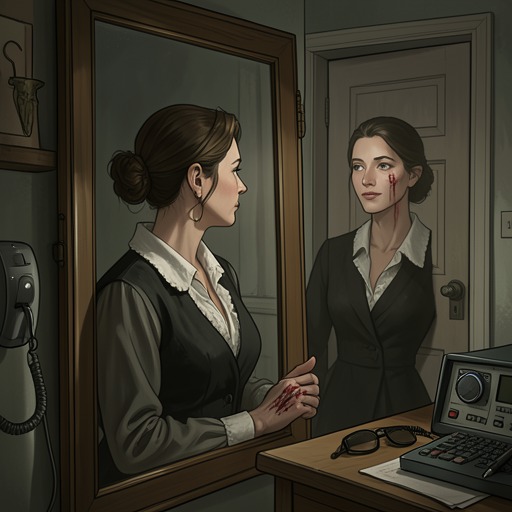
Leo returns from Boston and resumes contact with Emmi
Love VirtuallyLeo’s return from Boston briefly reopens his correspondence with Emmi, but it does not restore the relationship they had before his departure. His homecoming reveals that he has carried her as an idealized presence through nearly ten months abroad while also beginning a new relationship; Emmi’s reply turns that mismatch into a final appeal for a meeting, making the event a reckoning over what their intimate correspondence can mean in ordinary life.
Return and renewed contact
Three and a half months after an automatic notice says Leo’s email address has changed and incoming messages will be deleted, he writes to Emmi under the subject line “Back from Boston.” He has been back in the country for less than a week. His opening is tentative: after the long silence, he says he does not know what to say, and settles on a belated holiday greeting, hoping that Emmi is well. The exchange resumes, but the delay and awkwardness establish that it is not a simple continuation of their former rhythm.
The change of address had made contact seem impossible through the channel on which their relationship depended. Leo’s return therefore brings more than a new message: it reopens a connection that had been abruptly cut off. Yet the first note offers little explanation, and the brief greeting leaves Emmi to interpret what his return means. Her uncertainty soon becomes pain rather than uncomplicated relief.
The meaning of the silence
In her message about closure, Emmi describes the previous five days as worse than the painful feelings Leo had caused before, while acknowledging that he had also brought her exceptionally good feelings. She imagines him returning to Outlook ready for fresh correspondence with anonymous magazine subscribers and treating her name as barely familiar. This is her fear and accusation, not a confirmed account of his behavior; it gives the renewed contact its emotional stakes by showing how readily his silence appears to her as rejection and replacement.
Leo answers that he should not have written back if doing so would hurt her, and insists that she could never be a burden because she remains part of him. He says he carried her across continents and emotional landscapes during almost ten months in Boston as a fantasy and an idealized expression of love, and brought that imagined presence home. His words affirm the depth of his attachment while also revealing its form: during the separation, Emmi remained emotionally powerful as an inward figure, rather than as a shared daily relationship.
A life moving forward
That distinction becomes explicit when Leo says his physical life has moved on. He has met someone in Boston, and they want to try to build a relationship; she is considering taking a job in his country and possibly moving there. He does not present this new relationship as a denial of what Emmi meant to him. Instead, his message places the idealized bond and a developing relationship in separate spheres, while making clear that he is no longer offering Emmi the future she might hope for.
Leo also revisits the failed first meeting. He says that on the night it collapsed he cruelly ended their virtual relationship, and that Emmi had reached a decision even if she had not wanted to acknowledge it until the end. He describes their long silence as necessary to protect the singular quality of their experience and preserve what he calls their intimate non-encounter. In his account, the relationship reached its limit without crossing into a sustainable future; now, he asks Emmi to cherish what they had and leave it intact rather than risk ruining it.
Emmi’s request for a conclusion
In her reply, Emmi accepts that she will not ruin what they had, but her agreement is edged with disillusionment. She mocks the contrast between being preserved as an ideal and being unavailable in physical life, and says she will withdraw from Leo’s life, though not immediately. Her response refuses to let his language of cherished memory make the separation painless: to her, being loved as an ideal does not answer the desire for an encounter.
Emmi then asks for one hour face-to-face, presenting the meeting not as the start of a future but as the most fitting conclusion to their intimate non-meeting. She says she will demand and expect nothing beyond the hour, but wants at least once to see and speak to Leo. Her request makes the event’s central contradiction plain: Leo believes that avoiding another meeting protects the meaning of their relationship, while Emmi believes that a meeting could give that relationship an ending worthy of what it was.
The name Pamela and the unresolved ending
Leo’s next clarification is brief and specific: the woman he met is named Pamela, not Cindy, the name Emmi had guessed in her sarcastic imagining. He adds that Pamela does not look like her name suggests, then says good night. The correction supplies the new partner’s identity but does not answer Emmi’s request for an hour together, leaving the proposed conclusion unresolved in the evidence of this exchange.
The episode thus resumes contact only to expose how far the two have diverged. Leo returns with affection for the inner, idealized Emmi he carried through Boston and a new relationship grounded in his present life. Emmi, refusing to accept idealization as a substitute for encounter, asks for one last meeting. Their letters restore communication, but the crucial question is no longer whether they can write to each other; it is whether their non-encounter can be concluded by meeting at all.